What Is AI-Native CLM?
AI-native contract lifecycle management (CLM) is a new approach to managing contracts in which artificial intelligence is integrated throughout the contracting process, including drafting, review, negotiation, approvals, repository management, and ongoing contract analysis.
The distinction between traditional CLM and AI-native CLM goes beyond the addition of AI features.
Traditional CLM platforms were developed when software couldn't reliably interpret the contents of legal agreements. Organizations compensated for this limitation through structured metadata, predefined workflows, manual classification, and extensive configuration.
These constraints shaped how CLM systems were built, how they were implemented, and how organizations used them.
Generative AI is removing many of those constraints.
Today, AI can interpret contractual language, identify relationships between agreements, analyze historical negotiating positions, and answer questions across an entire contract portfolio.
The result is a different approach to contract management, with significant implications for how legal teams work and what businesses should expect from their CLM investments.
Why Traditional CLM Was Built Around Structured Data
To understand the significance of AI-native CLM, it helps to understand how traditional contract management systems evolved.
Legacy CLM platforms were designed primarily to organize documents, standardize contracting processes, and maintain structured information about agreements.
Because the underlying software couldn't interpret complex legal language, important contract information generally needed to be extracted and entered into predefined fields.
An organization that wanted to track termination rights, renewal dates, liability limitations, or assignment provisions first needed to establish the appropriate metadata structure.
If the company subsequently wanted to analyze something different, the relevant information might not have been captured.
The same limitations influenced contract repositories, search functionality, reporting, and workflow automation.
These systems could be highly effective at managing processes that had been anticipated and configured in advance. They were considerably less flexible when organizations needed to answer new questions or adapt to changing business requirements.
Consider an organization that wants to understand which customer agreements permit unilateral price increases.
If this information wasn't captured during implementation, the company may need to review the underlying agreements individually or undertake a new data extraction project.
The information exists in the contracts, but the software wasn't designed to interpret it.
This is one of the central distinctions between legacy and AI-native CLM: the ability to generate intelligence from the contents of agreements rather than relying exclusively on information previously extracted from them.
How AI-Native CLM Changes Contract Intelligence
The traditional contract repository was primarily a place to store, organize, and retrieve agreements.
AI-native CLM makes it possible to analyze contractual information continuously and across an organization's entire portfolio.
Several capabilities illustrate the difference.
1. From Folders to Contractual Relationships
A typical commercial relationship can involve a master services agreement, multiple statements of work, order forms, amendments, and supplemental agreements.
Traditional repositories often require users to organize these documents through folder structures, naming conventions, or manually maintained relationships.
AI can identify relationships between agreements based on their contents, including references to underlying contracts, amendments, and related documents.
This allows the repository to represent contractual relationships rather than simply maintain a collection of files.
For organizations managing thousands of agreements, this distinction is significant. Understanding an obligation often requires reviewing several related documents, not just the original contract.
2. From Predefined Reports to On-Demand Analysis
Traditional CLM reporting depends heavily on the information captured during implementation.
AI-native systems can analyze agreements in response to new questions, including questions that weren't anticipated when the repository was established.
A legal team might ask:
- Which agreements contain unlimited liability provisions?
- Which customers have negotiated exceptions to our standard termination language?
- Which supplier contracts contain change-of-control restrictions?
- Which agreements contain renewal provisions requiring notice within the next 90 days?
These questions can be answered through analysis of the underlying contractual language, even when the relevant information wasn't previously maintained as structured metadata.
Organizations can also create new contract fields, filters, and portfolio views as their reporting requirements evolve.
This reduces the dependence on predefined reporting structures and makes the repository considerably more useful for legal, finance, procurement, and business operations.
3. From Manual Tagging to Continuous Monitoring
Contract management has traditionally required considerable effort to keep information current.
Users manually review agreements, populate fields, maintain records, and monitor contractual obligations.
AI makes it possible to automate much of this work.
As new contracts enter the repository, AI can identify renewal dates, notice periods, key obligations, and provisions that require additional attention.
Organizations can establish ongoing monitoring rules that apply across their portfolio, reducing the need for repeated manual review.
The repository becomes a continuously updated source of contractual information rather than a static archive.
4. From Individual Contract Review to Portfolio Intelligence
Legal teams have historically reviewed risk primarily at the individual agreement level.
AI enables a broader approach.
Organizations can identify patterns across hundreds or thousands of contracts, including recurring liability concessions, unusual indemnification provisions, policy deviations, and terms that consistently create negotiation difficulties.
This makes it possible to understand how contractual risk is distributed across the business.
The same analysis can inform future negotiating policies, template updates, and commercial decisions.
For multinational organizations, multilingual analysis extends these capabilities across agreements drafted in different languages and jurisdictions.
How AI-Native CLM Changes Contract Drafting and Negotiation
Contract review and negotiation provide another important example of how AI changes established CLM functionality.
Traditional CLM platforms generally approach negotiations through templates, clause libraries, approval rules, and static playbooks.
These tools help establish consistent processes, but they have limitations.
A conventional playbook might specify preferred language, acceptable fallback positions, and circumstances requiring escalation.
Applying those rules still requires lawyers to interpret the agreement, assess the relevant context, identify deviations, and prepare appropriate revisions.
AI can assist directly with these tasks.
From Static Playbooks to Contextual Review
AI-native CLM can apply an organization's negotiating policies to the specific language and commercial context of an agreement.
Rather than simply identifying that a provision differs from a standard template, AI can explain the deviation, assess it against an approved playbook, and propose an appropriate revision.
This can include generating precise redlines directly within the document.
The objective is to reduce the manual work associated with routine contract analysis while preserving legal judgment over negotiating decisions.
From Institutional Memory to Precedent Intelligence
A second development may be equally significant.
Legal departments accumulate substantial negotiating history over time, but much of that knowledge remains buried in executed agreements.
Lawyers frequently rely on personal experience, previous matters, or informal discussions to determine which contractual positions the organization has accepted.
AI can make this information systematically accessible.
For example, a lawyer negotiating a limitation of liability provision could examine the positions previously accepted by the company in comparable agreements.
That analysis could be supplemented by external market intelligence showing how similar provisions appear in agreements across the broader market.
Combining internal negotiating history with external market precedent gives legal teams a stronger basis for evaluating contractual positions.
This is particularly relevant for organizations seeking greater consistency across legal teams, business units, and jurisdictions.
From Legal Department Software to Business Self-Service
Traditional CLM platforms have generally been designed around legal and legal operations teams.
Other departments may participate in intake, approvals, or electronic signature, but accessing information within executed agreements often still requires assistance from legal.
AI-native CLM creates an opportunity to change that relationship.
Consider a salesperson preparing for a customer renewal.
The salesperson wants to know whether the company can increase pricing, how much notice is required, and whether the customer has negotiated restrictions on price adjustments.
Historically, answering these questions could involve locating the relevant agreement, identifying subsequent amendments, and requesting legal assistance.
With AI-native CLM, the salesperson can ask the question directly.
The system can identify the relevant agreements, analyze the applicable provisions, and provide an answer supported by the underlying contractual language.
A procurement professional could similarly investigate termination rights across supplier agreements.
A finance executive could review contractual payment obligations.
An operations manager could identify obligations requiring action during a particular reporting period.
These capabilities depend on appropriate access controls, reliable source references, and the ability to recognize relationships between agreements.
They also create an important distinction between ordinary document search and contract intelligence.
Finding an agreement is useful. Understanding the rights and obligations established by that agreement is considerably more valuable.
AI-Native CLM Is Changing Implementation and Migration
The shift to AI-native CLM also has implications for how contract management platforms are implemented.
Traditional CLM deployments frequently involve extensive data preparation, metadata mapping, document classification, workflow configuration, and migration activities.
Organizations must decide in advance how agreements will be organized, what information should be captured, and how contracting processes should operate.
AI can reduce the amount of manual work involved in these activities.
Intelligent Contract Ingestion
Legacy agreements can be imported and analyzed without requiring every document to be classified and every metadata field to be populated beforehand.
AI can identify document types, extract relevant contractual terms, and establish relationships among agreements.
This allows organizations to begin deriving value from existing contract portfolios while progressively improving data quality and classification.
AI-Assisted Workflow Migration
AI can also assist organizations moving from an existing CLM platform.
Rather than manually recreating every intake form, approval process, and workflow rule, organizations can use AI to analyze existing configurations and help reconstruct them in a new environment.
These capabilities don't eliminate implementation requirements. Integrations, security, permissions, governance, and workflow validation remain essential.
But they can reduce the manual configuration and migration effort historically associated with CLM projects.
This is particularly important for organizations dissatisfied with an existing platform but reluctant to undertake another complex implementation.
From Closed CLM Systems to Connected Contract Intelligence
Traditional CLM platforms generally require users to access the system directly to retrieve contract information.
AI is creating opportunities to make contractual intelligence available across other enterprise applications.
Through integrations, APIs, and standards such as the Model Context Protocol (MCP), contract information can be made accessible to authorized AI assistants and business applications.
This means employees may be able to retrieve contract intelligence within the tools they already use.
For example, a customer account manager could access relevant contractual terms within a CRM workflow.
A procurement team could incorporate contract obligations into supplier management processes.
An internal AI assistant could retrieve information from the contract repository alongside other permissioned enterprise data.
The CLM platform remains responsible for maintaining reliable contractual records, permissions, and governance.
But the intelligence contained within those agreements becomes available across a broader range of business processes.
What Makes a CLM Platform Truly AI-Native?
As AI becomes a standard part of enterprise software, nearly every CLM vendor is introducing AI functionality.
This creates an important distinction for buyers.
A traditional CLM platform may incorporate AI-generated summaries, document search, or automated clause extraction while retaining much of its original architecture.
These capabilities can deliver meaningful value.
However, the presence of AI features doesn't necessarily mean the platform has been designed around the capabilities of modern AI.
An AI-native approach considers how AI can improve every stage of the contracting lifecycle, including activities that previously depended on extensive manual configuration or intervention.
This includes intelligent intake and routing, AI-assisted drafting and negotiation, precedent analysis, contract ingestion, portfolio intelligence, and ongoing obligations management.
It also requires conventional enterprise functionality.
Legal teams still need collaborative document editing, version control, configurable approvals, appropriate permissions, audit trails, reliable integrations, and structured processes.
AI-native CLM should combine these capabilities with AI-driven analysis and execution rather than treating AI as a separate application.
How Should Organizations Evaluate AI-Native CLM?
The emergence of AI-native CLM creates a challenge for organizations evaluating contract management software.
Traditional CLM purchasing processes frequently begin with extensive requirements documents and feature comparison matrices.
These often reflect the architecture of existing platforms.
Buyers evaluate metadata structures, reporting fields, workflow configuration, repository organization, and administrative capabilities.
These remain relevant considerations, but they don't fully reflect what AI-native platforms can now accomplish.
Organizations should also evaluate whether the software can perform tasks that previously required substantial manual work or weren't practical at scale.
A useful evaluation should involve real agreements and actual business questions.
For example, instead of asking whether a vendor supports custom metadata fields, ask it to identify a contractual risk across a sample portfolio without configuring those fields in advance.
Rather than reviewing a demonstration of a clause library, ask the vendor to analyze the organization's historical negotiating positions and explain how they differ from current policy.
Instead of evaluating repository search through predefined filters, ask the system to answer a question involving several related agreements and demonstrate where the answer originated.
And rather than accepting generalized implementation estimates, ask the vendor to ingest representative legacy agreements, establish their relationships, and demonstrate the effort required to make that information useful.
These exercises provide a more meaningful assessment of how AI changes the product.
They also help distinguish demonstrated capabilities from functionality that exists primarily in product demonstrations or roadmaps.
Five Questions Every CLM Buyer Should Ask
- Can the platform understand our existing contracts? Evaluate its ability to classify agreements, identify related documents, and extract useful information without extensive manual preparation.
- Can it answer questions we haven't anticipated? Test whether the platform can analyze contractual language and produce reliable, source-supported answers without requiring every field or report to be configured beforehand.
- Can it apply our negotiating standards and historical precedent? Assess whether AI can use company policies, playbooks, and previous agreements to support drafting and negotiation.
- Can our business teams use contract intelligence directly? Determine whether authorized employees can obtain useful answers without navigating complex repository structures or relying on legal for every inquiry.
- How much work is required to implement and maintain the system? Consider not only subscription costs but also migration, configuration, data maintenance, administrative resources, and ongoing changes to contracting processes.
The answers can reveal significant differences between platforms that appear similar in conventional feature comparisons.
AI-Native CLM Still Requires Governance and Legal Oversight
The ability of AI to interpret contracts doesn't eliminate the need for reliable contract management controls.
AI-generated answers and recommendations must be evaluated for accuracy, particularly where contractual language is ambiguous or multiple agreements govern the same relationship.
Effective platforms need to maintain clear links between analysis and source documents, respect user permissions, preserve auditability, and support appropriate human review.
Structured workflows also remain important.
A contract may be analyzed by AI, but organizations still need to manage approvals, enforce authority limits, maintain reliable records, and establish accountability for contracting decisions.
The objective is to reduce unnecessary manual work while preserving the controls required for effective legal and business operations.
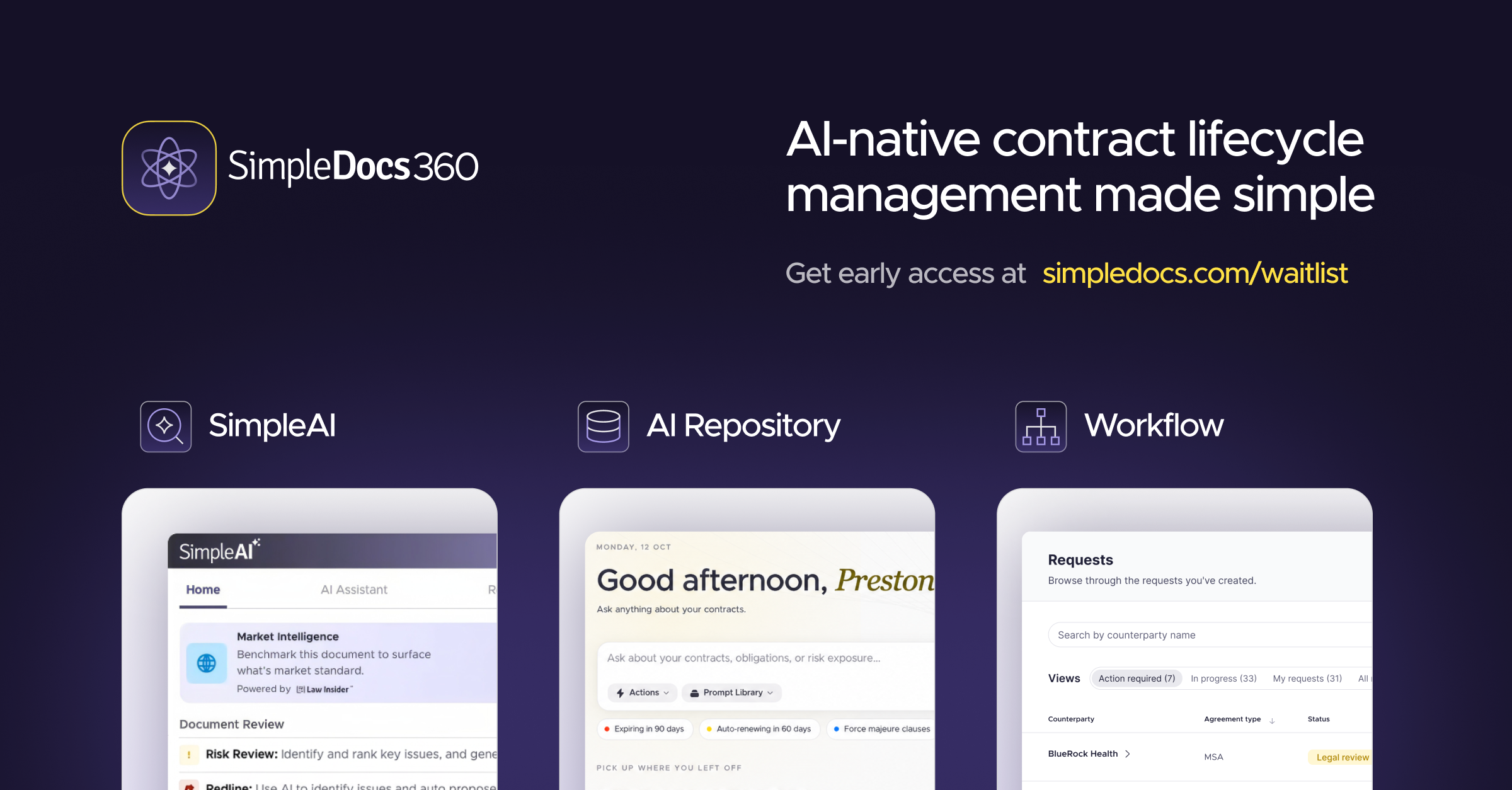
SimpleDocs 360: AI-Native Contract Lifecycle Management
SimpleDocs 360 was developed around this changing approach to contract lifecycle management.
The platform brings together business intake, approval workflows, collaborative drafting and review, AI-assisted negotiation, and an intelligent contract repository.
SimpleDocs also combines internal contract intelligence with Law Insider's extensive collection of public contracts and clauses, allowing legal teams to evaluate negotiating positions against both organizational precedent and broader market practice.
The objective is to make contract management more accessible across the business while giving legal teams greater visibility, control, and intelligence throughout the contracting lifecycle.
The Evolution of Contract Lifecycle Management
CLM software has evolved considerably over the past decade, but many of the assumptions underlying traditional platforms originated before generative AI.
These assumptions influenced how contracts were organized, how information was extracted, how workflows were configured, and how legal departments accessed historical negotiating knowledge.
AI is changing each of these activities.
Organizations can increasingly analyze existing agreements without extensive upfront data preparation, access negotiating intelligence across historical contracts, monitor contractual obligations continuously, and make contract information available throughout the business.
For companies evaluating CLM technology, this calls for a different approach to vendor selection.
A purchasing process built around the requirements of traditional CLM may overlook some of the most valuable capabilities of AI-native platforms.
The more useful starting point is to identify what the organization needs to accomplish, then evaluate how much manual work, configuration, and intervention the software requires to accomplish it.
That is where the differences between legacy and AI-native CLM become most apparent.