The Durability of Vertical Software in the Age of AI
AI is getting remarkably good at legal work.
Today's leading models can review contracts, identify risks, propose redlines, interpret complex provisions, and answer sophisticated legal questions. And these capabilities are improving rapidly.
That raises an important question for the legal technology industry: If general-purpose AI can perform much of the work that specialized legal software was built to do, what happens to those applications?
It's a question I've been thinking about following a discussion at the recent TLTF Summit with Jason Boehmig, Ironclad's founder and now a member of OpenAI's legal leadership team.
My conclusion is that better AI will certainly challenge some legal technology companies. But it may also make the next generation of legal software significantly more valuable.
The distinction comes down to the difference between intelligence and infrastructure.
Reviewing a Contract Is Not the Same as Managing One
Consider what happens when a legal team receives a contract for review.
An AI model can analyze the agreement, flag problematic provisions, and suggest alternative language. These are valuable capabilities, and they're becoming increasingly accessible.
But reviewing the document is only one part of the contracting process.
Someone still needs to determine which negotiating positions are acceptable, whether exceptions require approval, who has authority to accept certain risks, and how the resulting obligations will be managed.
The agreement may need to move through multiple departments, integrate with business systems, maintain a complete version history, and ultimately become part of a searchable repository.
These requirements don't disappear simply because AI becomes better at legal analysis.
The ability to perform a task is different from the infrastructure required to manage the work.
This distinction is particularly important for contract lifecycle management (CLM), where the value of the software extends far beyond reviewing and drafting documents.
Context Is What Makes Legal AI Valuable
Legal decisions are rarely made in isolation.
Consider a limitation-of-liability provision.
A general-purpose AI model may identify the risks and recommend alternative language. But what constitutes an acceptable position depends on much more than the words in the contract.
How have similar provisions been negotiated in the relevant market? What has the company historically accepted? What does its legal playbook require? Does the proposed exception need additional approval?
Answering these questions requires access to different sources of intelligence: market data, internal precedent, organizational policies, and established approval processes.
This is where specialized legal software has a meaningful advantage.
The opportunity isn't simply to build a better contract review tool. It's to connect increasingly powerful AI models with the institutional knowledge and business context necessary to make better decisions.
For legal teams, the difference is significant.
Instead of receiving generic recommendations, lawyers can work with AI grounded in their organization's negotiating positions, historical agreements, and relevant market intelligence.
And those recommendations can be connected directly to the workflows where decisions are made and recorded.
The Interface May Change. The Infrastructure Won't Disappear.
One of the most interesting possibilities for legal AI is that users may increasingly interact with software without opening the software itself.
Imagine receiving a contract by email and asking an AI assistant to review it.
The assistant retrieves the appropriate playbook, identifies issues, proposes redlines, and returns the document. Perhaps it even initiates an approval process or updates the contract repository.
The user never opens a traditional CLM interface.
But the infrastructure behind that interaction is still essential.
The system must identify the correct contracting entity, apply the organization's policies, retrieve relevant precedents, respect permissions, preserve document versions, and maintain an auditable record of decisions.
As AI agents begin taking actions independently, these requirements become even more important.
Legal teams need to know not only what an AI system recommended, but also what it did, what information it relied on, and whether it acted within approved parameters.
The future of legal software may be increasingly invisible to the user, but the need for trusted infrastructure isn't going away.
Better Models Raise the Bar for Legal Technology
None of this means existing legal technology vendors are protected from disruption.
Quite the opposite.
Products built around narrow AI capabilities will face increasing pressure as foundation models become more sophisticated.
A standalone tool that identifies contract risks or generates redlines may find it increasingly difficult to differentiate itself when those capabilities are available directly through ChatGPT, Claude, or other general-purpose AI systems.
And we shouldn't assume that model providers will remain limited to supplying intelligence. They're already expanding into tools, integrations, and agentic workflows.
The opportunity for legal software companies is to build beyond individual AI features.
Consider what better models make possible.
A CLM system could generate workflows from a company's contracting policies rather than requiring extensive manual configuration. A contract repository could answer sophisticated questions across thousands of agreements without relying on predefined metadata fields. An AI agent could eventually negotiate within approved parameters and automatically escalate exceptions.
These developments could fundamentally change how legal teams operate.
But realizing that potential requires more than a powerful model. It requires access to the right information, integration with business systems, and reliable controls over how work gets done.
The companies that successfully combine these elements will be positioned to deliver far more value than those competing on AI features alone.
What This Means for Legal Teams
For legal departments evaluating AI and CLM solutions, the implications are straightforward.
The most important question is no longer simply which product has the best AI model or the most impressive contract review demonstration.
It's whether the platform can bring intelligence into the broader contracting process.
Can it apply your legal playbooks and negotiating history? Can it connect legal review with intake, approvals, and business stakeholders? Can it turn executed agreements into accessible institutional knowledge? Can it maintain the governance and accountability required when AI begins taking action?
These are the capabilities that turn AI from an individual productivity tool into an enterprise system.
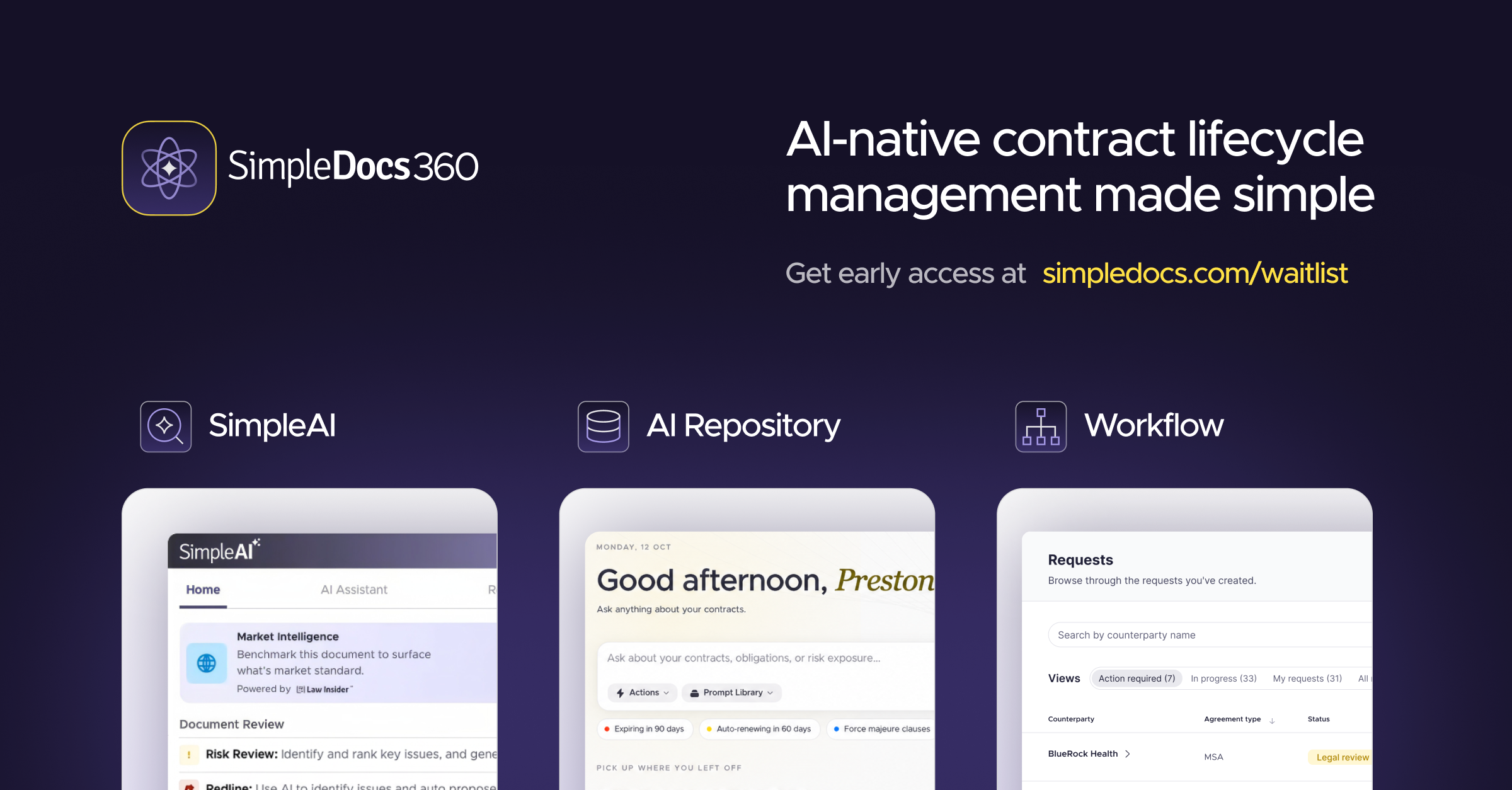
This thinking is central to how we're building SimpleDocs 360, our AI-native contract lifecycle management platform.
Our goal is to bring together contract intake, collaborative drafting and review, approval workflows, and an intelligent repository, with AI grounded in organizational playbooks, internal precedents, and Law Insider's market intelligence.
We believe legal teams should benefit from every improvement in AI without having to rebuild their contracting processes around each new model.
The Next Generation of Legal Software
We're entering a period in which intelligence is becoming more accessible, software interfaces are changing, and AI agents will increasingly perform work that previously required human intervention.
Some categories of legal software will undoubtedly become less valuable as a result.
But businesses will still need systems that define how decisions are made, who has authority to make them, where information lives, and how obligations are managed.
Better AI doesn't eliminate those requirements. It creates opportunities to address them in fundamentally better ways.
The future of legal technology won't be defined by which company puts the most powerful model behind a chat interface. It will be defined by which platforms turn that intelligence into reliable, accountable, and connected business processes.
That's why I'm optimistic about the future of legal software, and why I believe its most important innovations are still ahead of us.