What AI Adoption Looks Like for Higher Education Legal and Procurement Teams in 2026

Higher education legal and procurement hear about AI constantly. Conferences, vendors, peers, leadership. Everyone agrees it is “the future.”
But if you are managing vendor intake across decentralized departments, navigating institutional policies, coordinating departmental stakeholders, and keeping contracts moving without blowing up timelines, abstract AI promises do not help much.
What does help is understanding where AI can slot into the work you already do and quietly remove friction. Not as a transformation project. Not as a replacement for judgment. As a practical upgrade to everyday contract work.
This piece is about how higher education legal and procurement teams are actually putting AI tools to work in 2026 and seeing value without disruption.
Start With the Work, Not the Technology
AI adoption often fails because teams start with the tool instead of the task.
When procurement or legal teams hear “AI,” it can sound like an IT initiative. Long timelines. Heavy training. Governance reviews. New systems to learn.
That is not how successful adoption looks in practice.
The teams seeing traction treat AI like a workflow enhancement. Similar to how they rolled out e-signature, document management, or clause libraries. The tool lives where the work already happens, most often inside Microsoft Word, and supports specific review tasks rather than replacing the process.
If the tool requires your team to fundamentally change how they review contracts, it is already creating friction. The best AI fades into the background and simply makes review faster and more consistent.
Choose a Single, High-Frequency Bottleneck
The fastest way to stall adoption is trying to apply AI everywhere at once.
Instead, identify one contract task that:
- Happens repeatedly
- Follows clear institutional rules
- Consumes meaningful reviewer time
In higher ed, this often includes:
- First-pass review of software and SaaS license agreements used across the institution
- Cleaning up data-sharing or data-use agreements before internal routing
- Reviewing sponsored research agreements for standard institutional positions
- Flagging non-standard data protection, indemnity, insurance, or liability provisions in vendor contracts
Start with one of these. One document type. One reviewer. One short pilot window.
Apply your existing institutional guidance or fallback positions and let the tool assist with structured review, clause checks, and issue spotting. The goal is not perfection. The goal is measurable time saved on work your team already understands well.
Pilot With Practitioners, Not Committees
AI adoption does not need a steering committee to get off the ground.
Identify one or two colleagues who already handle high-volume contract review and are open to trying new tools. Have them use the tool on real agreements, not sample documents or demos.
Ask simple questions:
- Where did it save time?
- Where did it slow things down?
- Which suggestions were helpful?
- Which needed refinement?
Use that feedback to adjust internal guidance or playbooks. Then share concrete examples with the broader team. Seeing how a tool performs on familiar agreements builds trust faster than any abstract demo.
Use the Tool for What It Is Designed to Do
One common mistake is treating every AI tool like a general-purpose chatbot.
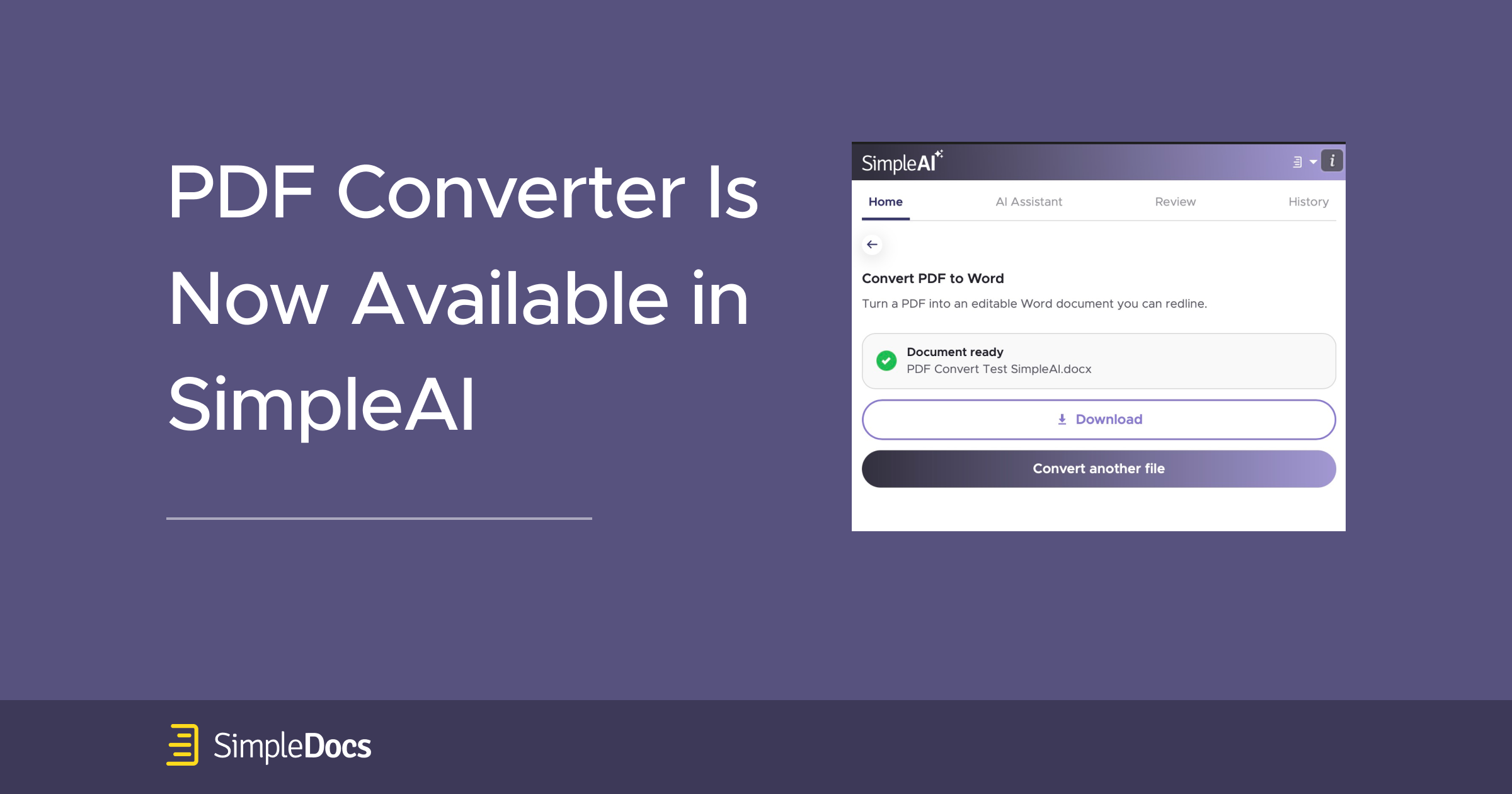
Tools like SimpleDocs’ Word add-in are not designed to replace judgment or answer abstract questions. They are built to support specific workflows like clause review, structured redlining, provision insertion, and playbook-based checks directly in the document.
Use them that way.
Avoid over-prompting or trying to force the tool into unrelated tasks. Let it handle the repetitive, rules-based work it excels at. Keep reviewers firmly in control of decisions. Every suggestion should be reviewable, editable, and easy to reject.
Whether you are applying your own institutional playbooks or leaning on established standards, the value comes from consistency and speed without sacrificing oversight.
Measure Success by Time and Consistency, Not Feature Use
The return on AI adoption is not how many features your team uses. It is how much time and mental load the tool removes from routine work.
With legal and procurement teams, , meaningful indicators include:
- Faster turnaround on standard vendor and license agreements
- Fewer manual redlines for recurring policy issues
- More consistent application of institutional positions across departments
- Reduced escalation cycles for predictable contract questions
If a reviewer can process five agreements in the time it used to take to review two, that is impact. If contract outcomes are more consistent across campus units, that is value.
AI is leverage, not magic. Measure it accordingly.
The Goal Is AI That Fades Into the Background
The most effective AI tools in the contract workflow are not the ones that draw attention to themselves. They are the ones that quietly support existing processes, enforce institutional standards, and give teams time back.
For legal and procurement teams, that time is better spent on vendor strategy, compliance planning, stakeholder alignment, and risk negotiation. The work that requires experience and judgment.
AI is not about replacing expertise. It is about reinforcing it, one contract at a time.
.png)