Introducing the Contract Intelligence Layer
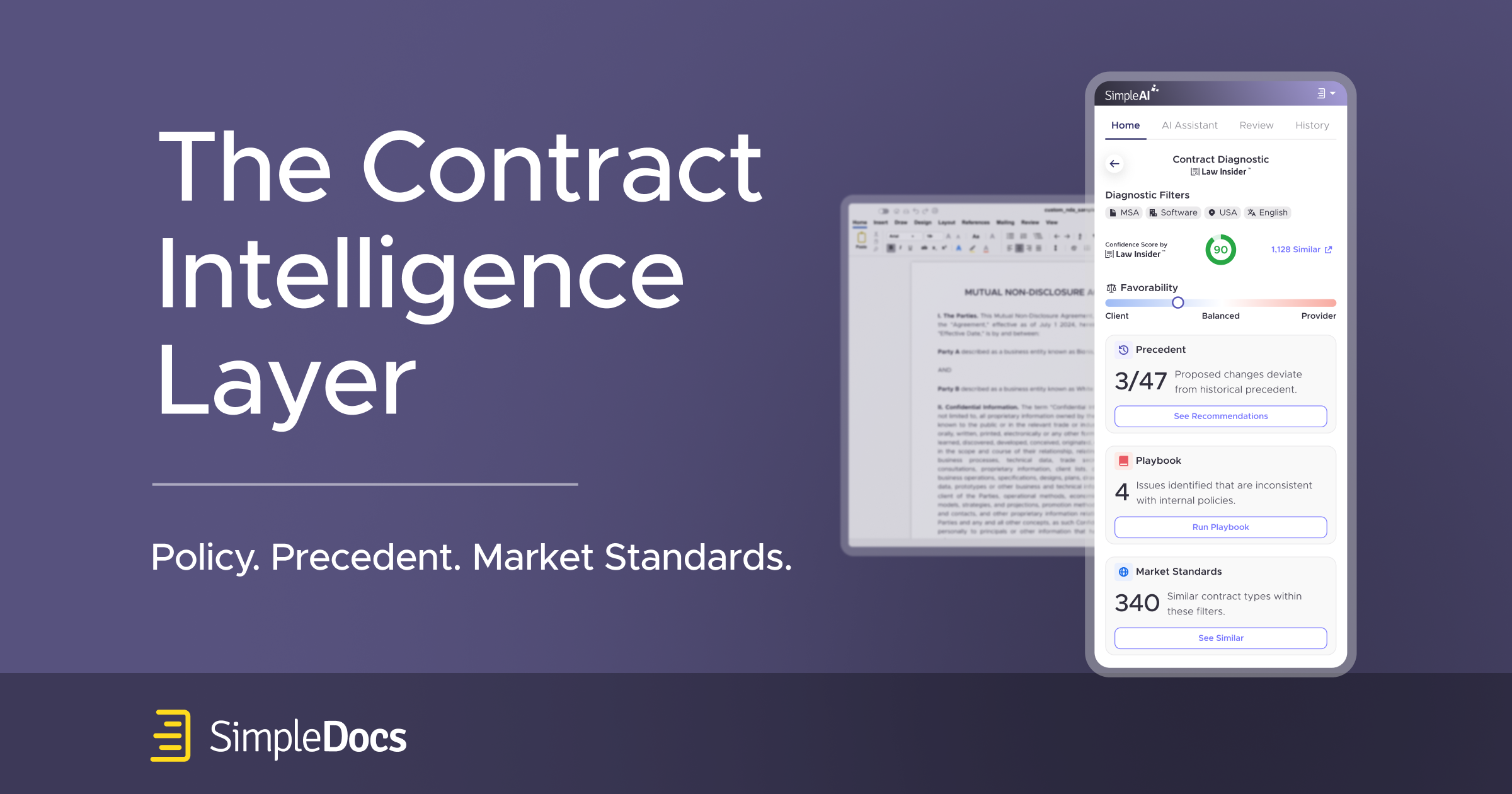
To negotiate well, a lawyer needs to know three things at once: what the market looks like, what their organization has actually done in comparable situations, and what their organization has formally approved. Today, most Legal AI tools address one of these at best and treat it as though it's the whole picture.
The SimpleDocs Contract Intelligence Layer is the first platform to brings all three together.
Why contract intelligence needs three dimensions
Think about how a well-prepared lawyer actually approaches a negotiation. They don't just check market standards . They don't just look at what the team did last time. They don't just consult the playbook. They do all three: cross-referencing external norms against internal history, against documented authority, and they synthesize a position from that intersection.
That process is sound. The problem is that it's manual, slow, and fragmented across different systems, different documents, and different people's memories. The information exists, but assembling it for any given clause in any given deal takes time that most legal teams don't have.
The Contract Intelligence Layer automates that assembly. It surfaces three distinct types of intelligence, together, in the flow of work.
Market Standards, powered by Law Insider, shows how comparable contracts are actually drafted across jurisdictions, industries, and languages. It draws from millions of publicly available, source-linked contracts - sourced from regulatory filings, government repositories, court filings, and publicly hosted agreements - and is updated daily. Every data point traces back to a real, public contract that can be verified, cited, and referenced in a negotiation.
Historical Negotiation Precedent shows how your organization has actually resolved comparable issues over time. Which clauses get negotiated most frequently. What fallback language your team has accepted in practice. Where concessions cluster by deal type, counterparty, or risk profile. Which terms slow deals down and which close quickly. This turns your negotiation history into structured intelligence rather than institutional memory locked inside old documents and email threads.
Documented Negotiation Positions and Fallbacks shows what your organization has formally approved. Primary positions, authorised fallbacks, escalation rules, exceptions. It tells you whether a proposed term aligns with existing authority, when additional sign-off is required, and where boundaries are non-negotiable. This encodes actual authority - not generic best practice.
No single layer is sufficient on its own. The intelligence is in the combination.
What this looks like in practice
A counterparty proposes an uncapped indemnity in a SaaS agreement.
Market Standards shows that uncapped indemnities appear in a minority of comparable public contracts for this agreement type. That's a useful data point, but it doesn't tell you what to do.
Historical Precedent shows that your team has accepted uncapped indemnities twice in the last three years - both for strategic accounts above a specific deal threshold, both with narrowly defined carve-outs. Now you have organizational context.
Documented Positions show that your approved fallback is a cap tied to twelve months of fees, with escalation required for anything beyond that. Now you have authority.
Three layers, one clause, one defensible path forward. The lawyer reviewing that contract doesn't need to guess, doesn't need to email three colleagues, and doesn't need to make an assertion they can't back up.
Showing the work
This matters because contract guidance that can't be explained can't be trusted.
Many contract tools, whether AI-powered or otherwise, provide conclusions without showing how they got there. A clause is "non-standard." A position is "above market." But when you ask where the conclusion came from, the answer is either someone's experience, a model trained on data you can't see, or a study published two years ago.
The Contract Intelligence Layer grounds every recommendation in something concrete: public, referenceable market evidence; observed internal negotiation outcomes; or explicit, documented negotiation authority. That means every recommendation can be explained to a client, cited in a board memo, and defended in front of a regulator.
This is a deliberate design choice. We think legal teams deserve tools that treat defensibility as a feature, not an afterthought.
Data and privacy
Market Standards is built on public contract data, not customer documents.
Your contracts are not published. Your documents are not pooled. Your data is not used to train any public model. The intelligence layers that draw on your organization's own data - Historical Precedent and Documented Positions - are yours alone, used solely within your own workflows.
The Contract Intelligence Layer is available now.
To see how it works with your contracts, request a demo: simpledocs.com/waitlist

.png)
