The Vibe Coding Paradox in Legal Tech
Legal tech is entering a new era where lawyers are not just buying AI software. They are building it, prototyping it, and open sourcing it.
This movement has a name: vibe coding.
Vibe coders are going viral on LinkedIn and Reddit with prototypes that seem to replicate the enterprise-grade tools offered by fast-growing, high-priced legal tech companies.
That raises a real question for anyone building or buying legal technology.
Is vibe coding a threat that will disrupt this industry? Should you build instead of buy?
My hot take on this:
Vibe coding is a demand generator for enterprise legal tech.
It creates vendor-agnostic Legal AI communities.
It shows off use case-specific applications of AI.
It teaches lawyers to prototype those applications.
And it creates confidence in the category for skeptical adopters.
What it doesn’t do is replace the need for legal tech software vendors.
The paradox
The paradox of vibe coding in legal tech is that it is designed, or at least positioned, as a disruptor to legal tech vendors.
There is an implied narrative that enterprise legal software is overpriced and overbuilt, and that modern AI tools let anyone build what vendors sell, but without the enterprise software price tag.
But in practice, the opposite is happening.
Vibe coding is expanding category awareness. It is accelerating education. It is giving legal teams a sandbox to test real use cases and applications. And it is increasing confidence that legal AI can actually work in the real world.
That confidence does not reduce demand for vendors. It increases it.
Because once legal teams believe the category is real, they stop asking “should we trust AI?” and start asking “who can deliver this safely, securely, and at scale?”
The builders are proving a point
A growing number of builders are showing what this looks like in public. People like Jamie Tso and Artur Serov are gaining traction not because they are writing about Legal AI, but because they are shipping prototypes that make it tangible.
That is why this moment feels disruptive. It looks like the enterprise product moat is shrinking in real time.
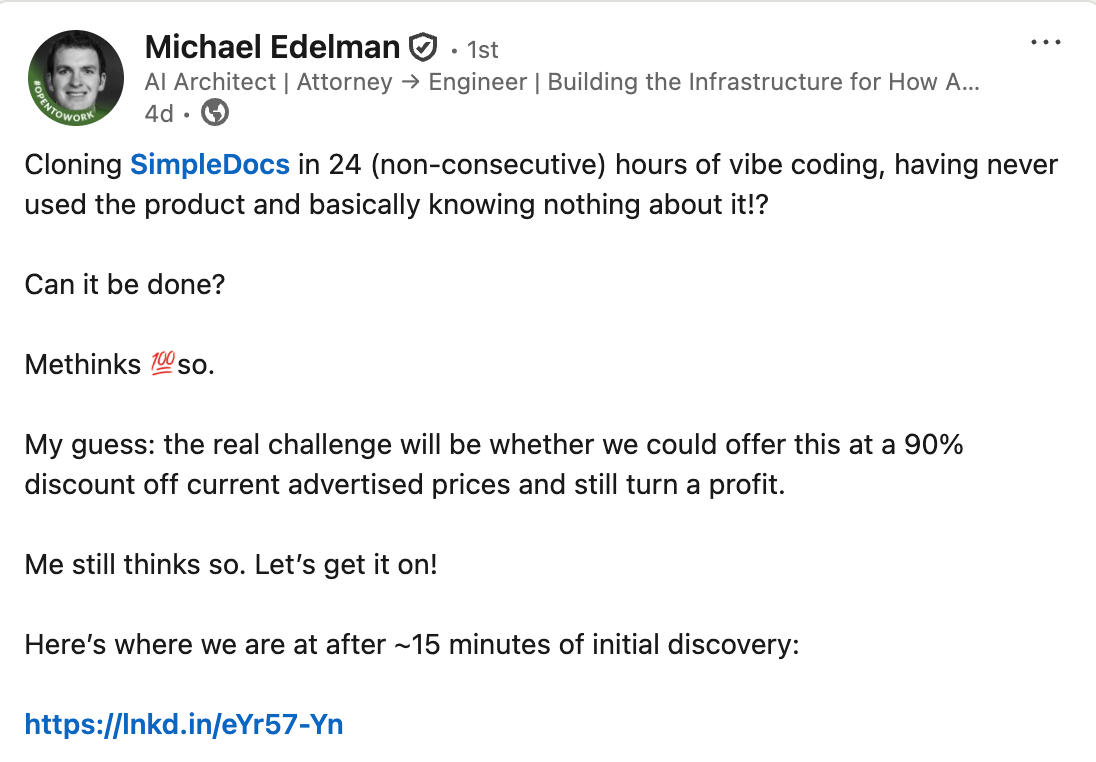
In a recent LinkedIn post, a vibe coder set his sights on SimpleDocs:
Why it will not replace enterprise legal tech
A talented vibe coder can absolutely recreate parts of enterprise legal tech products like SimpleDocs. They can replicate our workflows and our playbook builders. Recreate our AI Repository.
But enterprise legal tech is not just software. Software has been relatively easy and inexpensive to build for a long time. It wasn’t hard 10 years ago to replicate the software of a Clio or an Ironclad.
The real product (and the hardest part) is what happens after the prototype, when a legal team wants to deploy it across its organization. That is where the enterprise requirements show up.
Data privacy. Storage locations. Access provisioning. Advanced integrations. Custom implementations and configurations. Ongoing software and feature updates. Vendor accountability and support.
These are not nice-to-haves in enterprise software. They are the requirements buyers use to decide whether a tool can be trusted within a high-stakes environment.
The conclusion
Vibe coding may be positioned as a disruption to legal tech, but it is actually doing something far more valuable for the industry.
It is pulling the curtain back on what legal AI can do. It is accelerating adoption. And it is increasing confidence in the category.
Vibe coding does not kill the commercial opportunity.
It makes the commercial opportunity more accessible.
See what enterprise-ready legal AI looks like in practice. Get a SimpleDocs demo.
.png)