Vibecoding: Hype or the Future of Legaltech?


.webp)
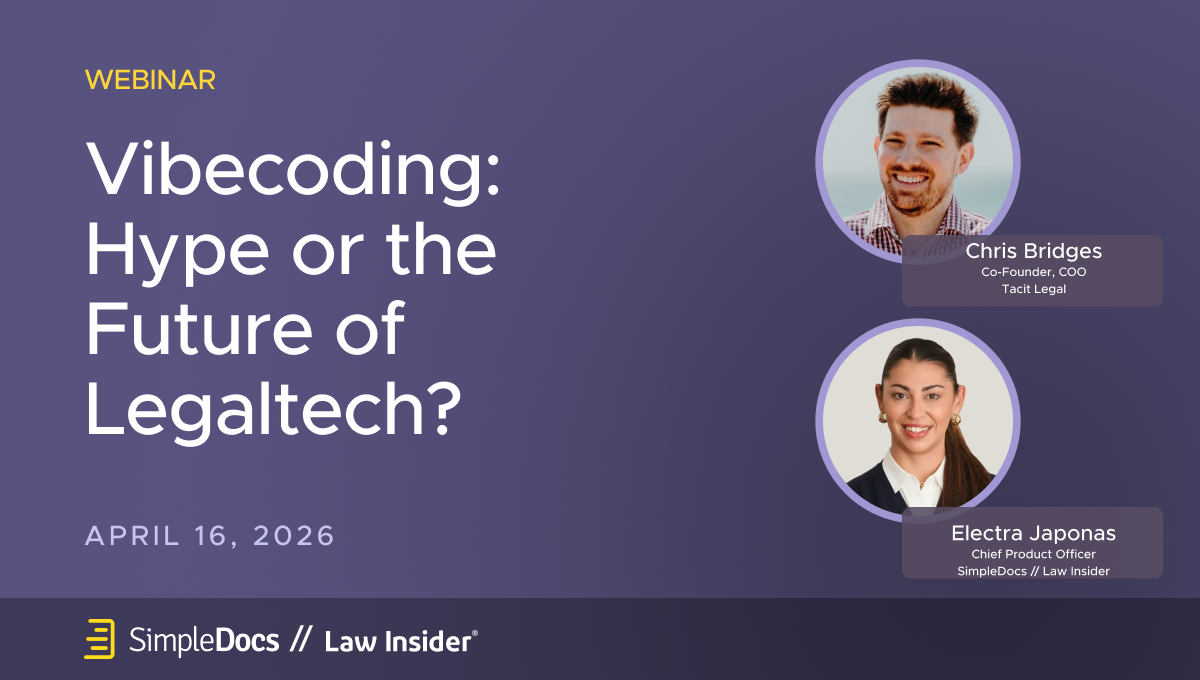


AI has made it easier than ever for legal teams to build their own tools.
In a short amount of time, you can create something that reviews contracts, flags issues, or suggests edits. And increasingly, teams are doing exactly that.
The question is no longer whether you can build, but whether you should.
In some cases, building internally makes sense. It can give you flexibility, control, and speed. In others, it introduces challenges that only become clear over time, particularly as you try to scale, maintain consistency, and rely on outputs across different matters.
Most teams are trying to figure out where that line is.
This session brings together two perspectives from people working directly in this space.
Electra Japonas (Chief Product Officer, SimpleDocs) and Chris Bridges (Co-Founder, vibecode.law, Tacit Legal, and Tilder) will discuss how legal teams are approaching the build vs buy decision today, what different approaches look like in practice, and where each tends to work best.
What You’ll Learn
- Why more legal teams are building their own AI tools
- When building internally makes sense and where it can add value
- How supervised and platform-based approaches compare in real workflows
- How to think about ownership, consistency, and long-term scalability
Why This Matters
Legal teams are being asked to adopt AI, often without a clear playbook.
Some are building internal tools. Some are investing in platforms. Many are experimenting with both.
At the same time, expectations are increasing around speed, consistency, and accountability.
This session is designed to help you think through those tradeoffs more clearly, based on what’s actually working in practice.
About the Host
Electra Japonas is the Chief Product Officer at SimpleDocs where she leads the product vision behind the company’s AI-powered contract tools. She works at the intersection of legal expertise and product design, helping shape how AI can be applied to real-world legal workflows like contract review, clause drafting, and playbook automation.
As the Founder of oneNDA, the global standard for NDAs, Electra brings a deep focus on standardization and usability to her work, pushing for tools that are not just smart, but genuinely adoptable.
Before joining the organization in 2024 following its acquisition of oneNDA, she was CEO and Founder of legal operations firm TLB, and held senior legal roles at the European Space Agency, Disney, BAT, and EY. She is a dual-qualified Solicitor (England & Wales) and Cyprus Attorney.
Chris Bridges is the Co-Founder and COO of Tacit Legal, a commercial law firm focused on structured delivery and operational efficiency. He also co-founded Tilder, a supervised AI contract review service, and vibecode.law, which explores how legal teams can build and experiment with AI-powered tools.
Chris has a background that spans law, application engineering, finance, and change management. He works closely with both buyers and vendors of technology, advising on contract negotiation, enterprise procurement, and data protection in complex, regulated environments.
At Tacit, he leads on technology, finance, and the firm’s supervised AI offering, giving him direct experience designing, deploying, and maintaining AI-driven legal workflows. His work focuses on simplifying and standardising legal processes, identifying what should be automated, and ensuring those systems hold up in practice.
Across his work, Chris brings a practical perspective on when it makes sense to build, when it doesn’t, and how to make either approach work effectively.